

MESHLINK News

Nov 06,2026

IEEE 802.15.4ab Technical Features and WELZEK UWB Test Solution

IEEE 802.15.4ab: UWB PHY Enhancement

IEEE 802.15.4ab builds on 802.15.4z to strengthen UWB RF and modulation capabilities. Its key areas are High Pulse Repetition Frequency (HPRF), Multi-Millisecond (MMS) ranging, sensing capabilities, and dynamic PHR formats (PHR1/PHR2) supporting BCC and LDPC coding. Backward compatibility with 802.15.4z/4a and non-interfering coexistence with Wi-Fi and Bluetooth are also central to the standard.


This article is compiled from information published by Welzek (Welzek link: https://en.welzek.com/gsdt/106.html)
HPRF: Higher-Speed Data and Ranging

HPRF is one of the core PHY upgrades. By increasing pulse density, it supports high-speed modulated signals and improved ranging performance. Alongside the legacy BPRF fixed rate of 62.4 MHz, HPRF introduces new mean pulse repetition frequencies of 124.8 MHz, 249.6 MHz and 1.95 MHz. Compared with BPRF, testing must handle higher sampling rates, wider analysis bandwidth, and real-time parsing of dynamic PHR and STS security sequences. Welzek also highlights data rates up to 124.8 Mbps and dynamic BCC/LDPC coding as key focuses of high-speed PHY testing.

MMS: Multi-Segment Signals for Better Ranging

MMS divides the ranging process into multiple 1 ms segments. Through repeated transmission and joint reception, it improves ranging accuracy, interference resistance, security and integrity.

UWB-Driven MMS: The HRP UWB PHY handles control, ranging and reporting, combining multiple ranging signals to boost sensitivity.

NBA MMS (Narrowband-Assisted): Narrowband channels carry control and reporting packets while UWB focuses on ranging. According to the vendor, this mode offers low power consumption and high link gain, at a higher cost.

OOB MMS (Out-of-Band): Bluetooth or Wi-Fi handles control and reporting, while UWB is dedicated to ranging.

UWB Sensing: From Positioning to Micro-Motion Detection

The UWB sensing mode described by the vendor uses UWB as a radar sensor. With the SENS packet format, low-sidelobe pulse waveforms and a standardized CIR (Channel Impulse Response) data output interface, it supports detection of subtle motion, vital signs such as breathing, and environmental scanning. Corresponding test systems need continuous CIR acquisition and micro-motion target simulation.


Test Requirements for Next-Generation UWB

Beyond high-speed PHY measurements, MMS requires continuous measurement of multiple ranging segments across UWB's wide bandwidth, making frequency accuracy more critical than in single-packet measurement. Rapid switching between narrowband and UWB also adds narrowband frequency measurement requirements. Sensing applications further require continuous CIR acquisition and micro-motion target simulation. When planning tests, bandwidth, frequency accuracy, continuous measurement and signal analysis capabilities should each be verified.

IEEE 802.15.4ab Technical Features and WELZEK UWB Test Solution

WELZEK T6290F UWB Test Solution

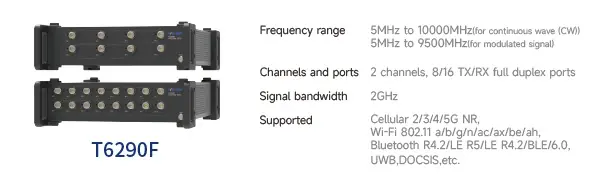
The T6290F wireless tester covers 5 MHz to 10 GHz with an analysis bandwidth of up to 2 GHz. According to the vendor, the platform supports all UWB channels; its UWB test options support MMS testing, and it is certified for FiRa PHY Conformance Test versions 1.0 to 4.0. Test coverage includes integrated UWB TX/RX solutions and OTA, AOA and TOF applications, for R&D labs and production lines in the chipset, smartphone, automotive and consumer electronics industries.

Meshlink is the exclusive distributor of Welzek in Taiwan. Welzek provides VSA/VSG solutions for production-line testing, covering 4G/5G/WiFi/UWB/GNSS/Bluetooth/LoRa/Zigbee and more. Meshlink offers consulting and equipment distribution services for WiFi, UWB and 4G/5G across production, R&D and certification. For product inquiries, please contact our network experts: support@meshlink.com.tw

↑